

In PSLE Chinese, Paper 2: Language Use and Comprehension is the biggest paper (90 out of 200 marks- 45% of total marks), so strong comprehension skills can make a big difference to your overall score.
Yet, when you read the passage carefully and understand every word, the marks still don’t add up. If that feels familiar, it’s a sign that comprehension involves more than just word recognition.
True comprehension calls for careful reading, sharp answering techniques, and the confidence to structure a clear answer under real exam conditions.
The encouraging part is that these are all skills you can learn with the right habits and consistent practice!
This article breaks down six practical tips to help you build stronger Chinese comprehension skills, for exams and everyday learning alike.
Understand What Chinese Comprehension Really Tests
It’s easy to assume learning Chinese comprehension is about recognising enough words to understand a passage because Chinese uses characters instead of an alphabet.
In reality, comprehension questions test student’s ability to understand how words and phrases work together to convey meaning, identify the main idea, and pick up on the key points within a passage.
Comprehension questions tend to fall into these categories:
- Vocabulary-in-context (词语理解) uses contextual clues to determine and explain the meaning of a word or phrase.
- Content or detail questions (内容理解) asks what happened, who did what, when, where and why, based on the passage.
- Inference questions (推断题) require you to read between the lines to understand hidden meaning or character traits.
- Feelings and lesson questions (感受/启示) explain characters’ feelings, infer the author’s message, or identify lessons from the passage clearly and logically.
Knowing these types matters, since each calls for a slightly different approach.
What’s more, strong comprehension requires careful inference and evidence-based reasoning.
In opinion-based questions, if students are able to interpret an author’s intent and understand why someone acts or feels the way they do, they can provide more accurate, nuanced answers.
6 Practical Essential Tips to Improve Your Comprehension Skills

#1 Read the questions first and build a simple story map
A simple habit can make a big difference: read the questions first so you know what the paper expects before diving into the passage.
Highlighting key words such as 为什么 (why), 怎么样的人 (what kind of person), or 从哪里可以看出 (from where can you tell) helps you know just what matters, so you read with purpose instead of trying to remember every sentence.
While reading, try building a simple “story map” in your head — for each paragraph, quickly note who is involved, where and when it happened, what took place, and why.
Lightly annotate the text by underlining key phrases and circling unfamiliar words, so it’s faster to locate contextual clues later when you need evidence to support your answers.
If you rush and only “scan” the passage once, it becomes easier to misread questions or miss important clues, and your answers may not match what the passage actually says.
Reading carefully with a simple “story map” in your head gives you a strong base to answer more accurately and calmly under exam conditions.
#2 Analyse the question and answer in structured sentences
Once you understand the passage, the next skill is analysing exactly what each question asks — content, reason, vocabulary-in-context, or feelings and opinions.
Some questions have more than one part, so watch out for missing a section (that’s an easy way to lose marks!).
Then match your answer style to the question type using simple templates and linking phrases, which can help you structure clear answers under timed conditions:
- For the reason questions (原因题), use “因为…所以…” to show cause and effect clearly, e.g. “因为他很着急,所以犯了错误。”
- For character or personality questions (特点/性格), use “从…可以看出他是一个…的人。” to connect evidence to a trait, e.g. “从他帮助同学的行为,可以看出他是一个乐于助人的人。”
- For feelings or lesson questions (感受/启示), use phrases like “我认为…因为…” or “这件事让我明白…” to express your opinion and the lesson you have learned.
Just as important, write your answers in complete, structured sentences instead of single words or fragments, so you answer what was actually asked, not just quotes from the passage.
Try to answer in your own words, especially for inferences and vocabulary-in-context questions to show you truly understand the meaning.
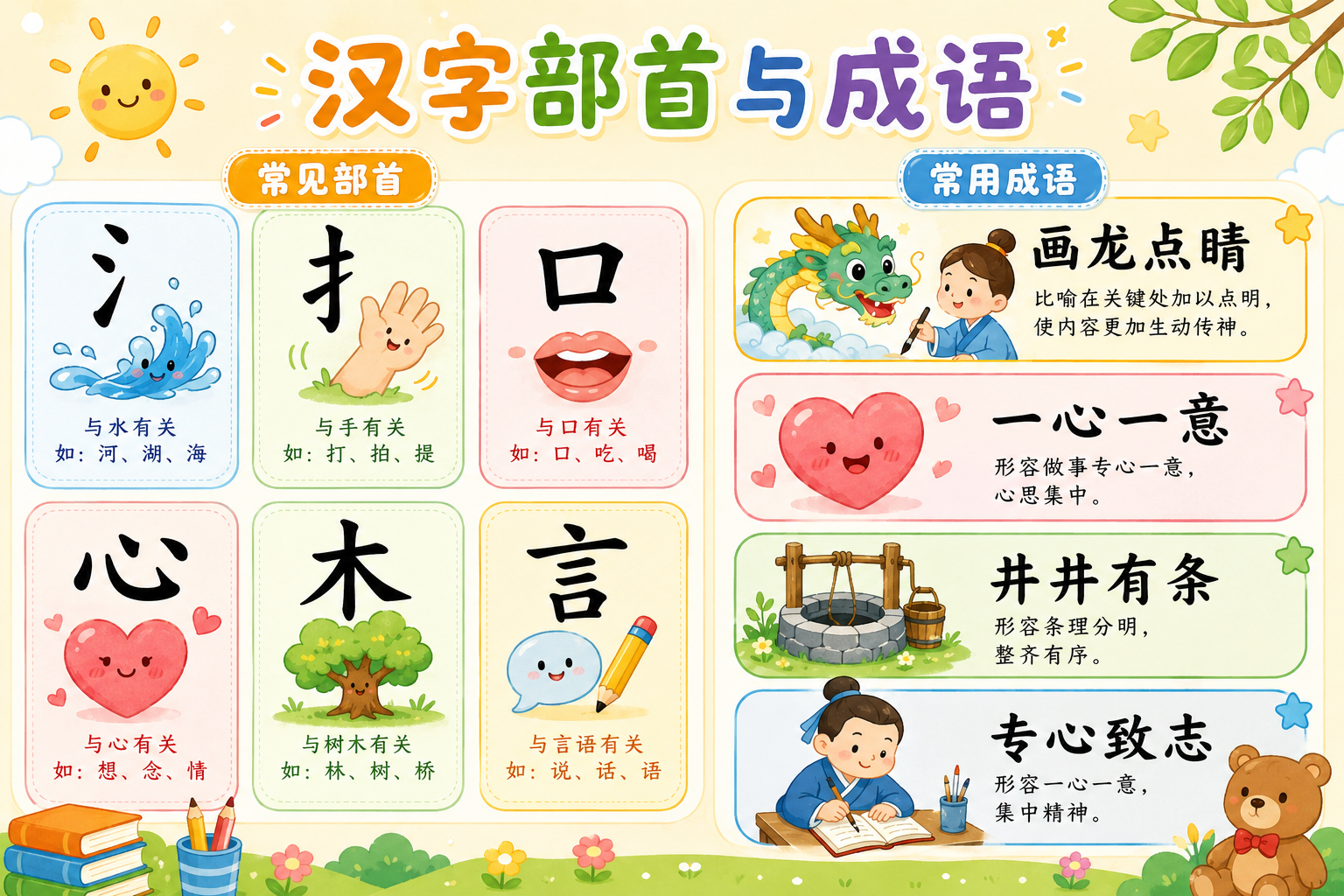
#3 Learn characters, radicals and idioms with spaced repetition
A lot of marks in Paper 2 come from vocabulary and language-use, so weak vocabulary often means losing easy marks before you even reach the harder comprehension questions.
That said, building a strong vocabulary doesn’t mean memorising long lists.
One powerful trick is to learn radicals, the small components inside Chinese characters, such as 扌 (hand), 氵 (water), or 讠 (speech), which often hint at a character’s meaning (though not every character follows this pattern) and make unfamiliar words easier to guess.
It also helps to learn high-frequency characters, phrases and idioms that often appear in textbooks, exam papers and stories.
A practical method to remember them is spaced repetition:
- Review new words today, again tomorrow, then next week and next month, instead of cramming once and forgetting.
- Use flashcards, a “好词好句” notebook, a dictionary app, or any tools where you can write down good phrases and idioms with a short example sentence.
Idioms and precise vocabulary are worth the extra attention, since they show a deeper understanding of written Chinese and make your answers clearer and more accurate.
Beware that vague vocabulary can cost you marks in comprehension answers and composition!
#4 Use past year papers and time practice with structured feedback
Doing more school worksheets helps, but to really prepare for exams, you need practice that looks and feels like the actual Paper 2 — this means past year papers and realistic timed practice.
Past year papers show you common question types, typical wording, and where examiners like to test your skills.
A simple, exam-smart routine could look like this:
- Once a week, choose one Chinese comprehension passage from a past paper and attempt it under timed exam conditions.
- After finishing, mark or review the answers with your teacher, tutor or parent.
- Mistake Analysis – analyse what your child do not know and spend equal time on structured feedback:
- Did you misinterpret the question?
- Did you copy the passage instead of explaining it in your own words?
- Did you lose marks for weak vocabulary or incomplete sentences?
Then, rewrite one or two weak answers using clearer structured sentences and more precise vocabulary, so you can actively fix the mistake and improve your answering techniques.
Over time, this kind of regular, exam-like practice builds better focus, time management, and accuracy, bringing you closer to full marks.
If you feel stuck even after trying these strategies, small-group support from a primary Chinese tuition class — like the kind that focuses specifically on comprehension skills, vocabulary and answering techniques — can give you more guided practice and structured feedback!

#5 Turn daily reading, listening and conversations into comprehension training
Comprehension improves fastest when Chinese is part of your daily life, not just a “test subject”.
You don’t need to study for hours; even 15-30 minutes of reading or listening several times a week, using storybooks, short articles, graded readers, cartoons, or audio stories can improve your fluency and build a natural sense of the language over time.
Everyday input can double as comprehension practice with a few simple prompts after reading or listening together:
- “What happened in the story?” (content)
- “Why did the character feel this way?” (reason or inference)
- “What do you think about what they did?” (opinion or lesson)
Try describing events and feelings in your own words, whether speaking or writing a short summary.
This low-pressure practice helps you structure ideas and use accurate vocabulary outside of exam conditions, while talking about the story with a parent, sibling, or friend supports both listening and reading comprehension in a way that feels natural rather than like extra homework.
For younger learners, programmes similar to Chinese kindergarten enrichment that emphasise stories, songs, movement and simple written Chinese can build early language skills and confidence in a playful way.
#6 Use a quick three-step check to avoid losing easy marks
Reviewing your work isn’t only about catching spelling mistakes, but also about spotting answers that don’t fully address the question, miss part of a multi-part question, or read unclearly.
Use this three-step self-check before moving on:
- Question: Did I answer exactly what the question asked?
- Evidence: Did I use the right detail or contextual clue from the passage?
- Sentence: Is my answer complete, clear, and written in correct Chinese?
It’s also worth checking pronouns and indirect speech whenever dialogue is involved — for example, the “我” in the passage has been correctly changed to the character’s name, or to “他” or “她”, where needed.
Beyond that, watch out for copied characters, missing words, and inaccurate vocabulary; even when you understand the passage well, a careless mistake can still cost you marks and affect overall accuracy.
This habit is useful for reading and listening comprehension, particularly under exam conditions when time is tight.
A few extra seconds of careful checking can turn a nearly correct answer into one that earns full marks.
Turn Comprehension Challenges into Steady Progress

If Chinese comprehension feels hard right now, you’re not alone. Many students in Singapore find Mandarin challenging, especially if they don’t hear or use Chinese at home every day.
Some students also face additional learning challenges, such as dyslexia or ADHD, which can make word recognition and sentence processing under exam conditions more demanding.
Instead of seeing low marks as failure, treat them as information:
- Are you losing marks because you misread questions?
- Because your vocabulary is weak?
- Because you rush and skip steps like analysing questions or checking answers?
Once you know where the marks are leaking, you can pick targeted strategies:
- More vocabulary and idiom practice with spaced repetition.
- Extra listening comprehension practice to train active listening.
- Focused comprehension drills with past year papers to improve answering techniques and time management.
Bottom line is, critical thinking gets better only when you practise regularly and receive structured comment from teachers, tutors or small-group classes.
Some learners benefit especially from dyslexia-friendly, multi-sensory lessons or specialised small groups that slow down the pace, provide visual support, and allow more time to practise reading comprehension and writing Chinese.
Strengthen Your Chinese Comprehension with Mandarinstars
If you’d like more structured support to put these tips into practice, Mandarinstars offers Chinese programmesdesigned specially for primary students who struggle with Chinese comprehension, vocabulary and written Chinese, including those scoring AL5–AL7 or facing learning gaps.
Our teachers focus on building comprehension skills, answering techniques, word recognition and confidence through small classes, exam-style practice and clear, step-by-step explanations.
What sets us apart is how personal the learning experience is. Classes are kept small — often just 2 to 5 students — so our teachers can adjust to your pace and needs, with real-time, personalised feedback.
To sharpen the grammar side of your comprehension and writing, our guide to Chinese Grammar: Sentence Structure, Rules, and Common Mistakes is also worth a read!
Ready to improve your Chinese comprehension? WhatsApp Us to find out which programme fits you best!

