

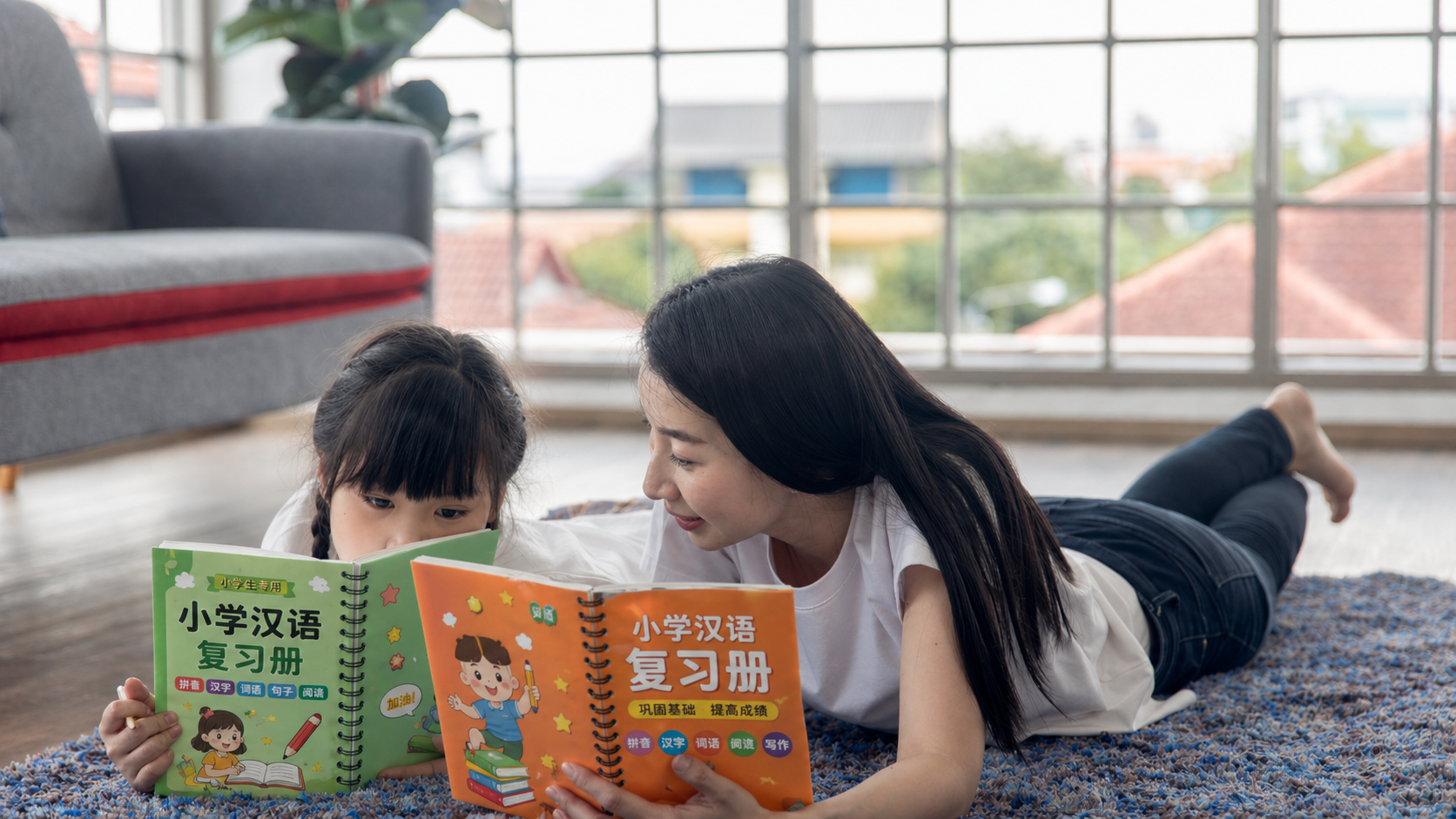
Many parents search for ways on how to teach Chinese at home — not because they want to take over the classroom, but because they want to do something meaningful to help.
The good news is that you don’t have to. Your role isn’t to be their teacher, but to become the steady support behind their journey to learn Chinese.
That means creating the right environment, building small habits, and showing up consistently in ways that make the language feel less like a subject and more like part of everyday life.
So, if you want to help more but don’t have the time to plan full lessons, this guide brings together realistic, low-effort ways you can support your child’s Mandarin Chinese learning at home!
Understanding Your Child’s Mandarin Journey
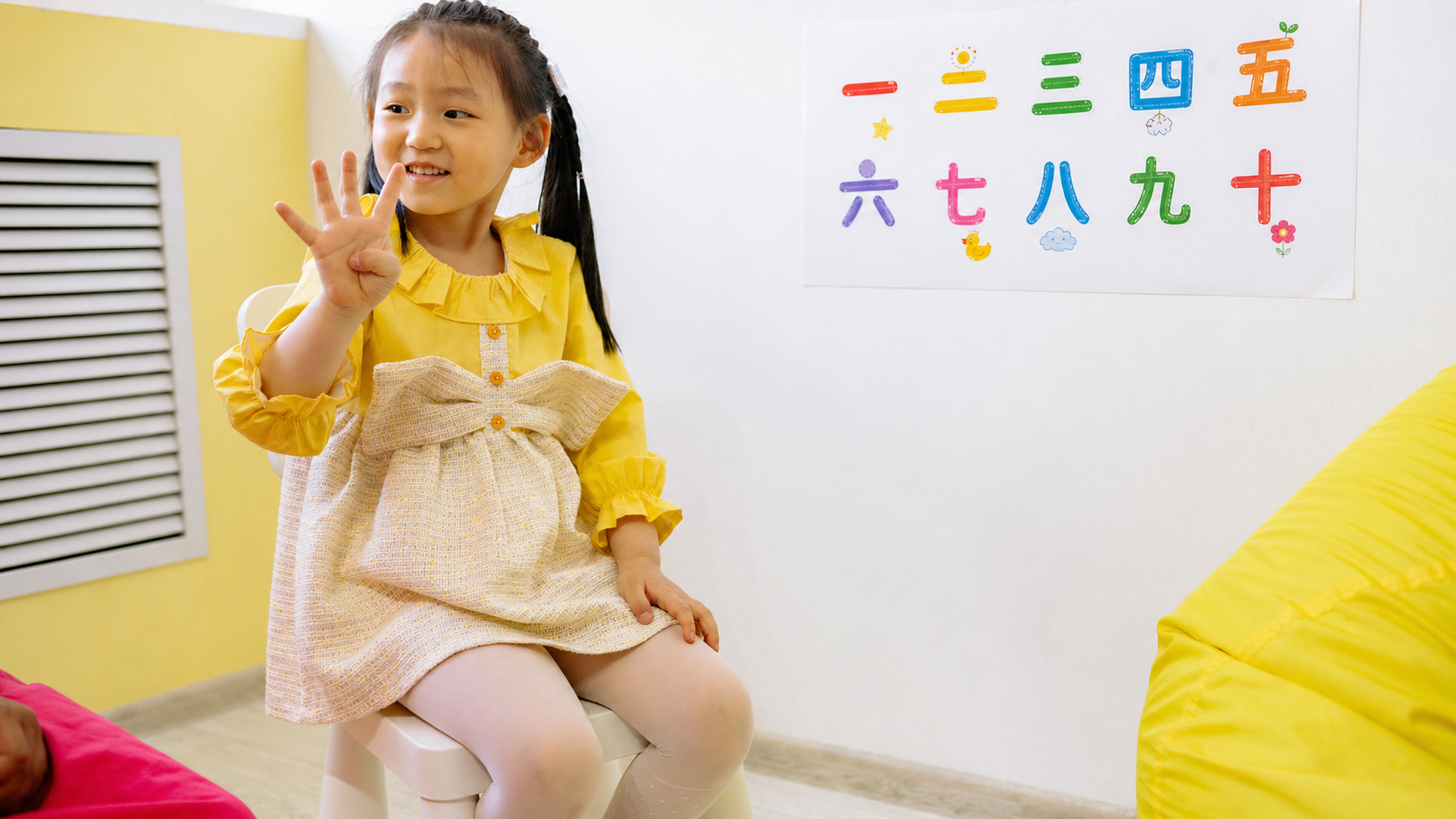
By the time your child enters Primary 4, they are expected to recognise and use over a thousand Chinese characters across reading, writing, listening, and speaking.
But for children who mainly speak English at home, it can be a tough feat to achieve the expectations as they get fewer chances to use the language outside of school.
This is not a reflection of your child’s ability, and it does not mean you have to reteach what happens in the classroom.
Your child’s teachers and structured lessons handle the core instruction; your role is to reinforce, encourage, and create an environment where Mandarin feels natural and accessible at home.
That kind of consistent exposure builds familiarity over time, and familiarity builds confidence.
Creating A Mandarin-Friendly Home

Use everyday moments to slip in simple Mandarin
You don’t need to carve out a fixed “Mandarin session” every evening. Instead, look for pockets in your existing routine where you can naturally introduce a little Chinese.
For instance, a simple “早安” in the morning, “你要喝水吗?” over dinner, or “我们走吧” on the way out already counts as meaningful practice.
And when you’re driving your child to school, ask them to point at things and name them in Chinese. These small moments, repeated consistently, help to normalise the language in your child’s world.
You don’t have to be fluent like a native speaker to do this. Even a handful of common phrases used regularly show that Mandarin is part of family life, not just another subject to “get through”.
Remember, daily short sessions are always preferable to long hours of stressful cramming!
Make Chinese visible around the house
Visual exposure to Chinese characters is a simple, low-effort way for language learners to build familiarity with pinyin and pronunciation over time.
There are ways you can go about this, such as printing or writing simple labels for common household items with pinyin— 门 (door), 桌子 (table), 冰箱 (fridge) — and sticking them where your child will naturally see them throughout the day, aiding in their overall vocabulary recognition.
You can also turn it into a fun guessing game: “Can you find the word for ‘window’?” This approach takes less than a minute but reinforces character recognition in a way that feels more like a challenge than a lesson.
Best of all? You just need to set it up once, and it works passively every single day!
(An important note: When it comes to pinyin, try not to overuse them as they can quickly become a crutch and even hinder progress.)
Help your child prepare for ting xie (听写)
Ting xie is one of the most consistent ways you can support Chinese learning at home, and it doesn’t require you to teach anything new.
All you need to do is sit with your child and go through the week’s character list together. Ask them to cover each word and write it from memory, then check it together. Aim for around ten characters per session.
It is a simple, repeatable routine that directly reinforces what they are already learning at school.
And because it is built around their own school materials, you never have to wonder whether you’re doing it “right.” The content is already there — you are just helping your child practise it.
Reinforcing Learning Chinese Through Play And Daily Routines

Turn playtime into light Mandarin practice
Play is one of the best ways for young ones to learn Mandarin, and you don’t have to force or fight your children into it.
Studying flashcards alone is often insufficient, especially if your child wants to improve their conversational skills.
Instead, try simple activities like:
- “I Spy” using Mandarin vocabulary
- A pretend market where your child lists food-related vocabulary in Chinese
- A game that incorporates physical movement
- Listening to upbeat Chinese nursery rhymes
Even better is if you can find a language partner, be it a friend or a family member, to join your playtime and enhance speaking skills this way.
Ultimately, the goal is to give your child as many natural, low-pressure chances to use Chinese as possible.
If your child fumbles a sentence or gets the Mandarin pronunciation a little off, that is completely fine. Practicing basic communication consistently is how confidence and accuracy are built over time.
Make reading in Chinese a short daily habit
Although extensive reading allows for better vocabulary acquisition, the goal should be to start small.
Having a daily reading routine — even for just 10 to 15 minutes — is the most natural way to build character recognition, reinforce sentence structure, and expand vocabulary.
At the end of a book, ask them to point out a character they recognise or talk about what happened in the story — in either language. It all counts.
If you’re not confident in your own Chinese reading, use storybooks with hanyu pinyin, audio pens that can read text aloud, or even bilingual books.
Additionally, it helps to listen to native speakers as it will familiarise your child with the natural rhythm of the language and distinguish between all the different tones.
You can learn alongside your child, or simply listen and respond with interest. After all, having a peer can increase motivation and accountability when studying!
What matters most is that the habit happens regularly.
Check in on their Chinese homework
If you want your child to engage actively with Chinese while trying to balance everything else on your plate, start by spending the first few minutes of their revision together.
Ask them to read a sentence aloud, point out a character they recognise, or explain what a word means in their own words. If they are stuck, redirect gently — “Can you check your notes or textbook first?” — rather than giving them the answer straight away.
This small check-in signals that Chinese matters, and helps your child to engage actively with the material before working independently, which builds better retention than simply filling in answers without thinking.
You don’t need to stay for the whole session. A brief start-together, work-independently routine is enough to keep your child going.
Build Simple Habits To Learn Mandarin Chinese At Home
Lean on ready-made books, apps, videos, and audio recordings
You do not need to create any learning materials yourself.
Graded readers aligned with MOE levels, popular apps built for vocabulary, video lessons, and audio recordings that complement school textbooks already exist — and they’re easy to integrate into your child’s routine.
The key is to pick one or two that suit their current level and use them consistently.
A simple, repeatable approach to learning Chinese at home will almost always outperform a packed schedule with a huge amount of different activities done sporadically.
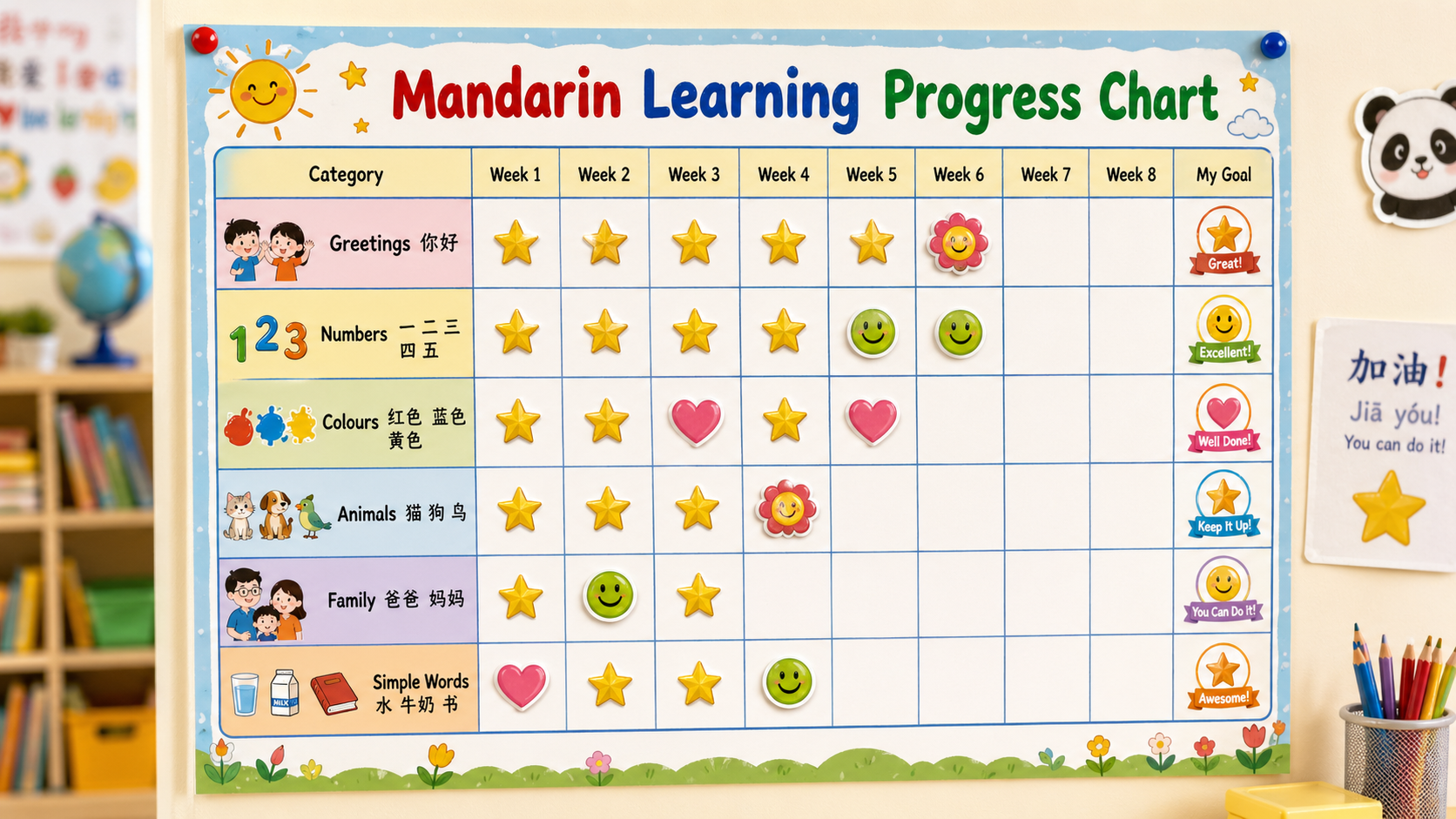
Track small wins and celebrate with simple rewards
Progress in Mandarin Chinese is not always visible in report cards, especially in the early stages.
While experts estimate that reaching native-level proficiency can take 2,200 hours or 88 weeks of active study, don’t let this number discourage or hasten your child’s language learning journey.
Start with implementing SMART goals (specific, measurable, achievable, relevant, time-bound) to keep things personalised to the learner and their progress.
With these goals in place, keeping a simple weekly record — new characters recognised, sentences your child can say, or pages read — helps you see what they have genuinely retained, which in turn helps you know where to spend your next few minutes of practice together.
Use it as a sticker chart your child can fill in themselves, earning a mark every time they hit their goal.
Pair this with a small reward system: once they hit a certain number of ticks or stickers, celebrate it. Let them pick the bedtime story, choose the song for the car ride, or earn a small treat of their choice.
This way, you keep motivation steady and, importantly, keep learning Chinese associated with something positive rather than something to dread.
When Home Support Alone Isn’t Enough
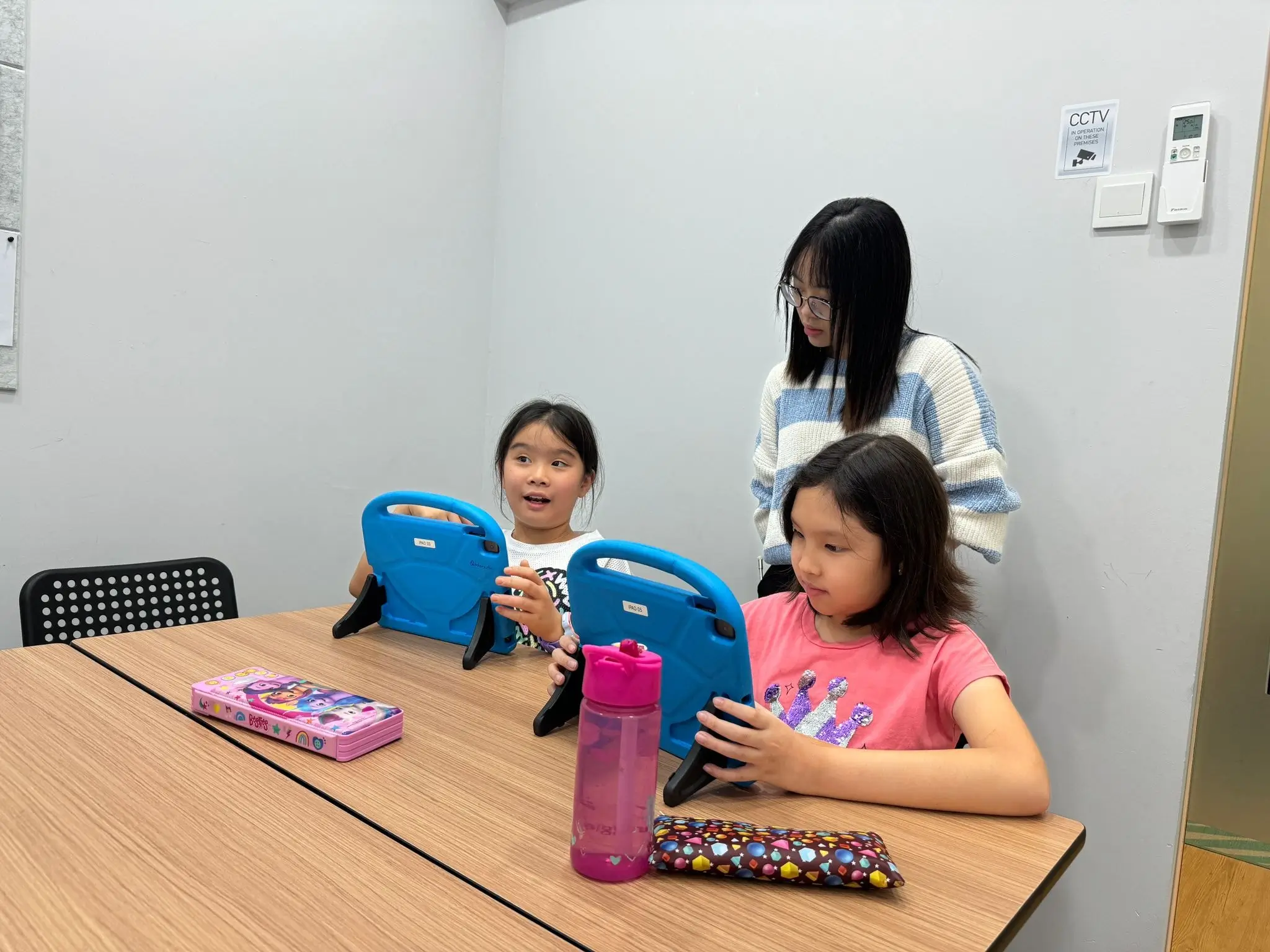
If your child is consistently scoring in the lower AL bands or struggling to remember basic characters even with regular practice at home, it may be time to explore more structured support.
It does not mean you have not done enough — it may simply mean they need an approach that goes deeper than what home reinforcement alone can provide.
For instance, children with dyslexia, ADHD, or other learning differences may respond better to a dyslexia-friendly Chinese tuition programme that uses multi-sensory methods and memory-based strategies alongside MOE-aligned content.
And if you have kindergarten-aged kids, consider enrolling them in a Chinese-enriched kindergarten environment to gain an early familiarity with the language, so they enter Primary 1 with more ease and confidence.
If you’re unsure whether your child is having any difficulties, check out our article on Learning Difficulties: 7 Early Signs to Look Out For before deciding on the next steps.
Make Every Effort Count, At Home and Beyond

The bottom line is you also don’t need to be a native Mandarin speaker or a teacher to help your child — just a parent who is willing to try and stay consistent.
By consistently applying the tips from this guide, you are building something no classroom can replicate on its own.
At the same time, there are things a trained Chinese teacher does that are simply beyond what most parents are equipped — or expected — to do:
- Identifying learning gaps with precision
- Scaffolding lessons to the right level
- Guiding sentence construction and oral fluency
- Adjusting in real time when a student is not progressing
These are specialised skills that take years to develop — and exactly why the strongest results come from the combination.
When steady home support meets guided, expert-led instruction, that’s when children truly move forward.
Start Your Child’s Chinese Journey With Mandarinstars
Even with the best home routines in place, some children need more focused guidance to truly find their footing.
If your child is still struggling to keep up, losing confidence, or hasn’t quite found their stride with Chinese, our specialised support at Mandarinstars can help you give them the structure and guidance they need.
Here’s what you and your child can expect when you get started:
- A targeted, structured Chinese programme where many students have improved by at least one AL grade — built on a clear, step-by-step approach
- Expert teachers who break every concept down into bite-sized, manageable steps using psychologically and academically backed methods
- A supportive, low-pressure environment where lessons move at your child’s pace
- Comprehensive skill development across reading comprehension, spoken fluency, and written composition
- An initial trial lesson where teachers assess your child’s current level and recommend the class setting that gives them the best chance to progress steadily
You’ve already taken the first step by being here — reach out to us now and let’s figure out the best path forward for your child together!

