


If your child has ever come home saying, “I don’t understand my Chinese paper at all,” you’re definitely not alone.
Many parents in Singapore – especially those who don’t speak Mandarin at home – feel unsure how to support their child when Chinese becomes the subject pulling their PSLE score down.
In Singapore’s primary education system, every child must take a Mother Tongue Language (MTL) such as Chinese, Malay or Tamil. For students who need additional support, schools may offer a Foundation-level MTL pathway with a simpler syllabus and assessment structure.
For parents, however, the important question is not simply “Is Foundation Chinese easier?” It is whether it is the right pathway for your child and what it means for their PSLE results and secondary school options.
This guide explains what Foundation Chinese is, how it’s assessed against Standard Chinese, and how you can build your child’s confidence along the way.
Understanding Foundation Chinese In Singapore
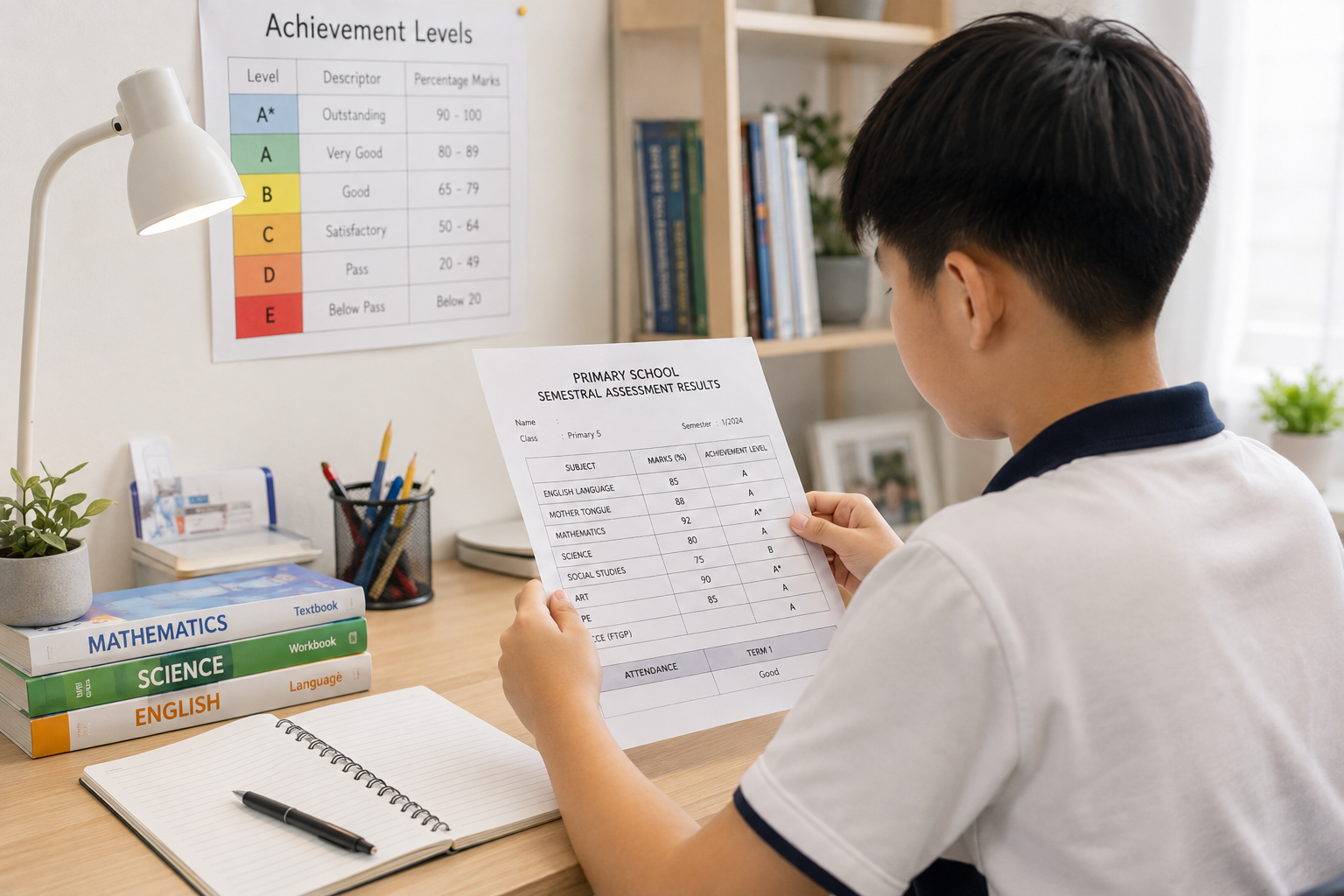
What “Foundation” means in the PSLE system
“Foundation” is not a completely separate subject. It is a lower-level syllabus designed for students who may need more time and support to build their skills in subjects such as Chinese, Mathematics and Science.
Students taking Foundation Chinese still sit an examinable PSLE subject. However, their Foundation-level grades are converted to Standard-level Achievement Level (AL) equivalents for PSLE scoring.
The current conversion is:
- Foundation AL A (75–100%) → Standard AL6
- Foundation AL B (30–74%) → Standard AL7
- Foundation AL C (<30%) → Standard AL8
This means Foundation Chinese still contributes fully to your child’s PSLE sum, but it cannot count as a very strong AL1-AL5 in the way Standard Chinese can.
That distinction matters when you are considering your child’s overall PSLE score and possible secondary school pathways.
How Foundation Chinese differs from Standard Chinese
The biggest difference is the level and structure of the examination.
Standard Chinese places a heavy weight on writing — students must write a composition of at least 100 Chinese characters on Paper 1, with Paper 2’s reading comprehension and language usage carrying the biggest weight.
The 4 papers total 200 marks:
- Paper 1: Composition Writing – 40 marks (20%)
- Paper 2: Language Use & Reading Comprehension – 90 marks (45%)
- Listening Comprehension – 20 marks (10%)
- Oral Communication – 50 marks (25%)
Foundation Chinese has a simpler three-paper structure, totalling 100 marks:
- Paper 1 – Language Use & Comprehension (15%)
- Shorter texts, basic vocabulary and grammar, simpler reading comprehension
- Paper 2 – Oral Communication (55%)
- Reading aloud and conversation based on a video or picture stimulus
- Paper 3 – Listening Comprehension (30%)
- Multiple-choice questions based on short spoken passages
Foundation Chinese has no composition paper at all. Instead, the examination places greater emphasis on listening skills and speaking, with simpler vocabulary, shorter passages and more multiple-choice questions, testing whether a student can genuinely use everyday Chinese.
For a child who finds lengthy written Chinese particularly difficult, this can make the examination more manageable.
Who is Foundation Chinese designed for?

Schools typically recommend Foundation Chinese for students who genuinely need a slower, more supported language pathway, such as:
- students who consistently score in the lower AL bands in Standard Chinese.
- students with a small vocabulary bank and grammar gaps who struggle with reading long passages.
- students from non-Chinese-speaking homes with limited language exposure.
- students with dyslexia, ADHD, and other learning differences that make reading and writing Chinese particularlychallenging.
However, Foundation Chinese is not simply a choice based on one poor examination result.
Schools typically look at a child’s performance and progress over time, including their ability to cope with the Standard-level syllabus.
Parents should therefore discuss the decision with the child’s teacher rather than treating Foundation Chinese as simply an “easier Chinese” option.
Is Foundation Chinese Right For Your Child?
Foundation Chinese can make Chinese more manageable for some students, but it also comes with implications for PSLE scoring and secondary school options.
It is therefore worth considering both the benefits and trade-offs before making a decision.
Pros and trade-offs to consider
Possible benefits:
- A simpler syllabus and exam structure can reduce anxiety for students overwhelmed by Standard Chinese.
- Better focus on listening, speaking and understanding everyday language can allow students to build confidence instead of repeatedly encountering material that is beyond their current level.
- Allow the student to focus on building his competencies for other three core subjects (English, Mathematics and Science).
Important trade-offs:
- Because Foundation Chinese is capped at Standard AL6–AL8, it will mean that the student will take Chinese langauge at G2 or 1 level in secondary school.
- Some secondary schools do not offer Chinese langauge at G2 and G1 level , so taking Foundation may limit school options.
In other words, Foundation Chinese may make sense academically and emotionally for your child, but it should still be considered as part of their wider PSLE and secondary school plan.

Questions to ask before deciding
Before deciding whether Foundation Chinese is appropriate, consider these:
- Is the struggle mainly with reading and writing, or speaking and listening too?
- Has your child had consistent exposure and practice, or is the gap more about exam technique?
- Depending on your schedule, how much support can you realistically provide over the next year or two?
- What impact could Foundation Chinese have on your child’s PSLE score and preferred secondary school options?
A conversation with your child’s teacher can help you understand whether the issue is a temporary learning gap or whether a different syllabus level would be more appropriate.
Understanding How Chinese Works As A Language
Writing system, radicals and stroke order
Chinese uses a logographic writing system with each character representing a syllable and often carrying meaning, rather than being built from individual letters as in English.
Many characters contain radicals that hint at meanings or categories (for example, “water”, “hand”, “heart”), which teachers use to explain vocabulary and help students remember new words.
Characters are formed from basic strokes (horizontal, vertical, left-falling, right-falling, hooks, etc.), and following the correct stroke order is essential to help children write neatly and remember characters under exam conditions.
Foundation Chinese students learn these basic strokes and radicals too, but at a simpler level and slower pace.

Tones, Pinyin and simplified characters
Spoken Mandarin Chinese is a tonal language: the same syllable with different tones can have different meanings, so accurate tones are crucial for speaking and listening.
Schools use Hanyu Pinyin, the official romanisation system that writes Mandarin sounds with the Latin alphabet and tone marks, to teach pronunciation systematically.
In Singapore, students learn simplified Chinese characters, which generally have fewer strokes than traditional characters used in places like Hong Kong and Taiwan.
Even Foundation-level students need some exposure to radicals, stroke order, Pinyin and tones as these are part of the language foundation that supports both Standard and Foundation Chinese.
If your child struggles to distinguish the four tones, practise them one at a time rather than trying to master all four at once. For a more detailed guide, see our article on Mandarin 4 Tones Made Easy: A Step-by-Step Guide to Clearer Chinese Pronunciation!
How To Support A Child Taking Foundation Chinese in Primary School
Once you understand what Foundation Chinese involves, the next step is helping your child build the skills they need outside the classroom.
Building everyday exposure and speaking practice
Because Foundation Chinese focuses primarily on listening and oral communication, building these skills at home makes a big difference.
You can:
- Play short Mandarin audio stories or songs for 5–10 minutes daily so your child hears more Chinese in relaxed conditions.
- Encourage simple speaking practice: let your child describe a picture, talk about a short video, or share their day in Mandarin, even if they mix in English.
As Chinese-language educators, we often find that with consistent practice and gentle feedback, oral fluency can improve noticeably within 2-3 months, even for weaker students.

Reading and listening to vocabulary and grammar
Even without a composition paper, reading still matters. Daily reading practice supports vocabulary, grammar understanding and reading comprehension.
Here is what you can do:
- Use picture-rich storybooks or graded readers; aim for 10–15 minutes of reading a few times a week.
- Let your child listen to the audio while following the text – this links listening skills with character recognition and meaning.
Seeking the right support
If you’re not confident in Mandarin yourself, working with a specialised Chinese tutor or centre can make Foundation Chinese less overwhelming for both you and your child.
A good primary Chinese tuition should work on the skills your child actually needs — such as listening comprehension, vocabulary, sentence construction and oral practice mirroring actual PSLE exam formats — with small class sizes letting teachers adjust pace to each child.
For children with dyslexia, ADHD or other learning differences, it may also help to work with a dyslexia tutoring and special needs programme that uses structured and multi-sensory approaches to make Chinese characters and vocabulary easier to process and remember.
Can a Child Move from Foundation Back to Standard Chinese?
Why switching back may not be possible
Students are usually offered Foundation Chinese MTL by their primary schools in Primary 5 or 6 if they are struggling to cope with Standard Chinese. Because the Foundation Chinese MTL syllabus is different, students who move to Foundation Chinese may not have the language skills or meet the competency or requirements needed to cope with Standard Chinese.
What It Takes to Bridge the Gap
A student cannot simply switch from Foundation Chinese back to Standard Chinese. If a school is considering the move, the student would first need to build up the skills covered in the Standard Chinese syllabus.
Bridging this gap requires sustained, structured practice rather than a quick fix. Depending on the student’s starting point, it may take 8-12 months to develop the level of proficiency needed to cope with Standard Chinese.
Chinese-language teachers generally find that oral and listening skills can improve more quickly, while composition writing and longer reading comprehension passages tend to require more time and practice.
A diagnostic assessment, either through the school or a Chinese tuition centre, can help identify the student’s specific gaps before deciding whether a return to Standard Chinese is appropriate.
Building early foundations in kindergarten
For parents with younger children still years from the PSLE, early exposure can reduce the chances of this struggle happening at all.
A play-based Chinese kindergarten programme that builds listening, speaking and basic character recognition before Primary 1 gives children a head start, so primary school Chinese feels far less daunting when it arrives.
Turn Understanding Into the Clear Next Step

Foundation Chinese does not have to be viewed as a permanent label. For some children, it can be a more manageable pathway while they strengthen their language foundations.
At home, focus on a few simple habits:
- Keep practice short and frequent. A calm ten-minute routine most days beats an anxious hour once a week.
- Celebrate small wins. New words mastered, a tone said correctly, one story completed — each is genuine progress toward a score that reflects real effort.
- Talk to your child’s teacher specifically. Ask about listening skills, reading comprehension and oral performance, not just the overall score, so you understand exactly where support is needed.
- Don’t overlook oral prep. Speaking carries heavy weight in both Foundation and Standard Chinese, so it deserves dedicated attention.
Every child moves at their own pace. The goal isn’t to rush toward a score; it’s to help your child achieve real skill in Chinese and build enough confidence in the language to become a manageable part of their education.
Get Expert Support from Mandarinstars
If the PSLE examination formats and scoring rules have left you unsure about where your child stands, MandarinStars can help you understand what they need to work on.
Mandarinstars works with primary school students across Singapore, including those in the Foundation stream and those with dyslexia, ADHD or other learning differences, using small class sizes and a pace built around each child.
Classes mirror actual PSLE exam formats: listening comprehension, vocabulary, sentence construction, oral practice and reading comprehension, so your child builds skills and exam familiarity together. Mandarinstars Learning Centre offers a structured, results-oriented curriculum for Foundation Chinese MTL — built specifically for Primary 5 and 6 students, and one of the few of its kind in Singapore.
Every new student starts with a trial class, giving you and the teacher a clear sense of their current level before choosing a programme.
If you’d like to talk through your child’s situation, WhatsApp us. We’re happy to offer practical advice on what may be most appropriate for your child.

